The Science of the Room
The research behind better pitches and better meetings. Why the people you pitch to say no, why groups full of smart people produce less than they could, and how to rehearse for both. Written for anyone who wants to know where an idea comes from before trusting it.
Three parts. One idea: the room decides.
Most pitches and meetings fail for reasons you can’t see from where you stand. Each part looks at one of those reasons and at what the research says works.
Part 1 · Pitch
Ch. 1–3How the listener decides.
Why listeners screen before they score, the four kinds of room every pitch meets, and how to build personas that help instead of mislead.
- How the listener decides
- The four rooms
- Personas done right
Part 2 · Meeting
Ch. 4–5Why sessions underdeliver.
Three voices, twenty people: the four ways groups lose ideas and decisions, and five rules for running a session that hold up in the research.
- Why sessions underdeliver
- Five rules that hold up
Part 3 · Practice
Ch. 6–7Rehearse, then check.
Why rehearsing against pushback works, what an AI can and can’t do as a sparring partner, and how to read a study yourself.
- Rehearsing against pushback
- How to read the evidence
15 printable tools to put the book to work.
Plain language first. Then the evidence.
Every idea is explained in plain words. The key studies follow in boxes called “Inside the evidence”: what the researchers asked, how they studied it, what they found and what to keep in mind.
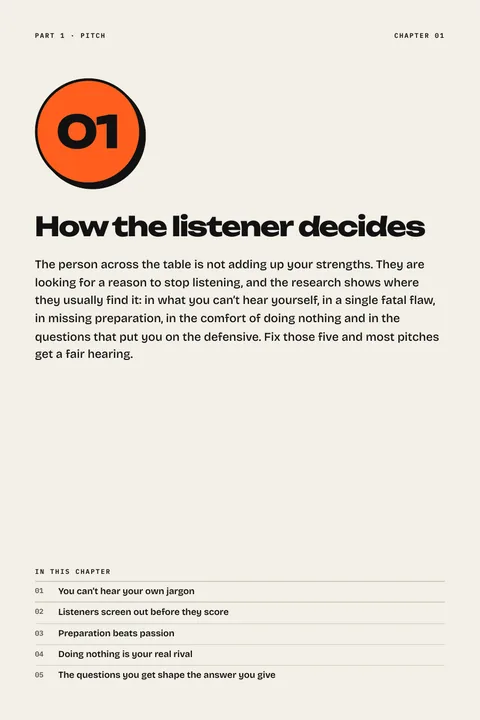
What happens in the room, and why.
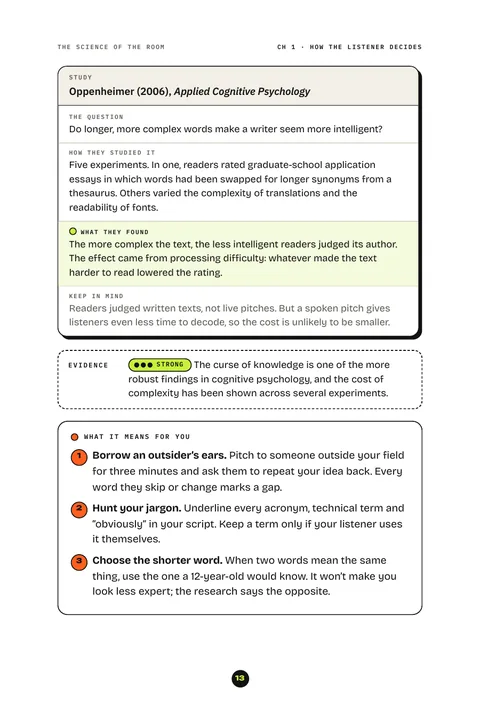
The study behind each idea, with its limits and a rating.
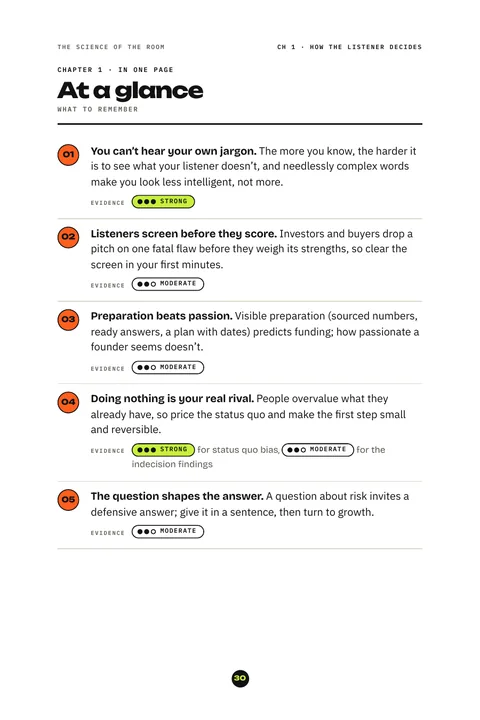
The chapter on one page, each finding rated.
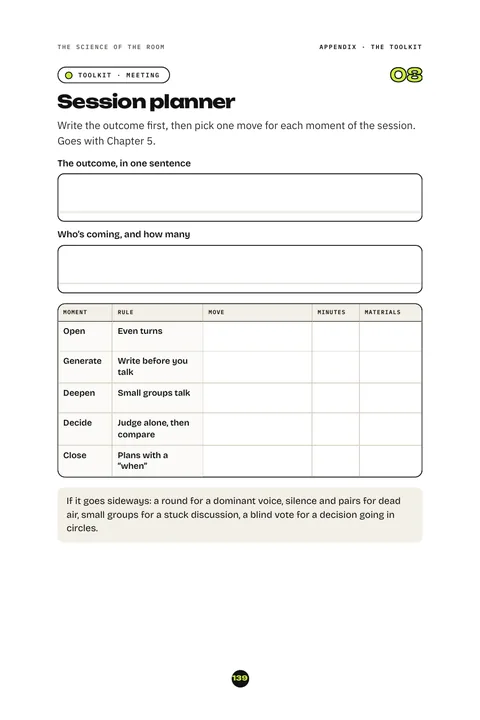
Worksheets and session plans to print and use.
Every finding says how sure we are.
The book and the kits use the same three ratings, so you always know what you’re standing on. Chapter 7 shows how to judge a claim yourself, including the ones in this book.
Several well-designed studies, or a meta-analysis, point the same way.
A few good studies, or strong evidence from a nearby setting that probably transfers.
Experienced practitioners have used it for years, but it hasn’t been formally tested. Not a weaker word for wrong.
For people who walk into rooms.
Founders, project leads and anyone asking for a yes
Learn how investors, buyers, funders and allies screen a pitch, and what to fix before you walk in.
Facilitators, teachers and team leads
See why open discussion loses ideas and decisions, and which simple structures bring every voice in.
Tough Room and Room Moves owners
The kits tell you what to do. The book tells you why, so you can adapt a card and explain it to a group.
The Science of the Room.
Instant download through Gumroad. Read it on screen, on a tablet or on paper.
The full book, by David Zavala.
- 153 pages, 7 chapters, 6 × 9 in PDF
- 59 key studies explained, and 81 sources
- An “At a glance” page and “On Monday” actions for every chapter
- 15 printable tools: worksheets, planners and three ready-made sessions
Read before you buy.
- The introduction and the whole of Chapter 1, How the listener decides
- One tool from the toolkit, and the chapter’s sources
- No sign-up: it opens as a PDF, and it’s yours to share
Put the research to work in the room.
- Tough Room: rehearse your pitch against 24 evidence-based personas
- Room Moves: 36 facilitation moves to run any session
Before you buy.
Do I need the kits to read it?
No. The book stands on its own. It mentions the cards where they put an idea into practice, so if you own a kit, you’ll see where each card comes from.
Is it an academic book?
No. It’s written in plain language for people who pitch and run sessions. Every key claim has its source, so you can check it, and Chapter 7 shows you how.
What format is it?
A 6 × 9 inch PDF with bookmarks, easy to read on a laptop, a tablet or a phone, and ready to print.
Can I print the tools?
Yes. Print as many copies of the toolkit pages as you need for your own practice and for the sessions you run. Please don’t share or resell the book file itself.
Is it available in Spanish?
Not yet. The book is in English for now. If you need it in Spanish for a class or a program, tell us.