Room Moves
36 evidence-rated facilitation moves for every moment in the room. Open strong, get every voice in, decide without groupthink, and rescue the session when it goes sideways.
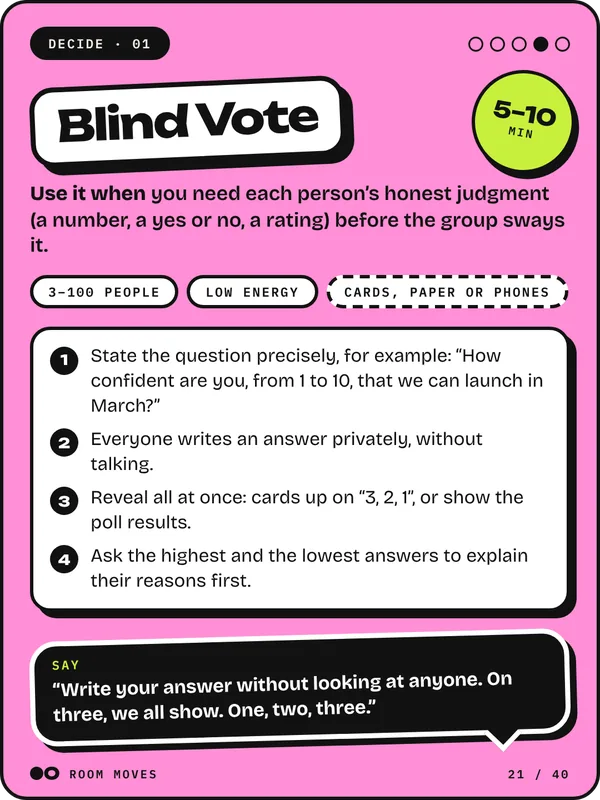
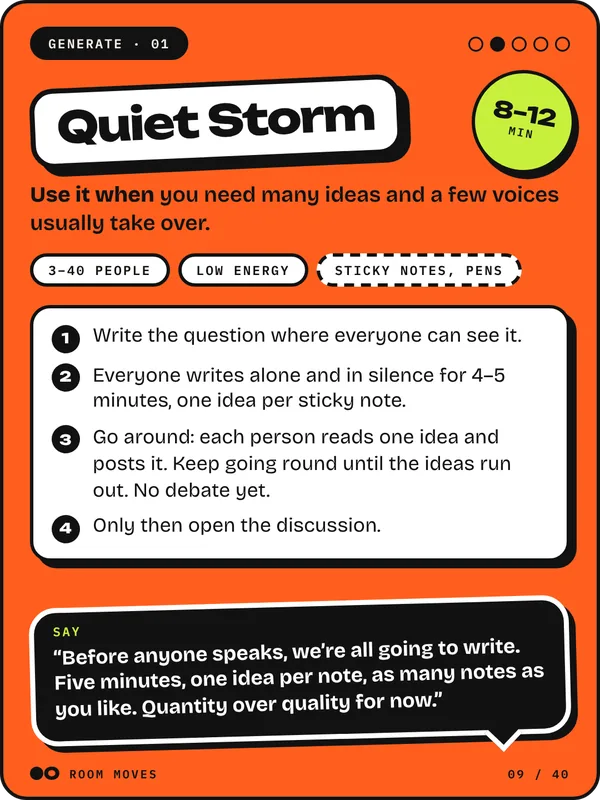
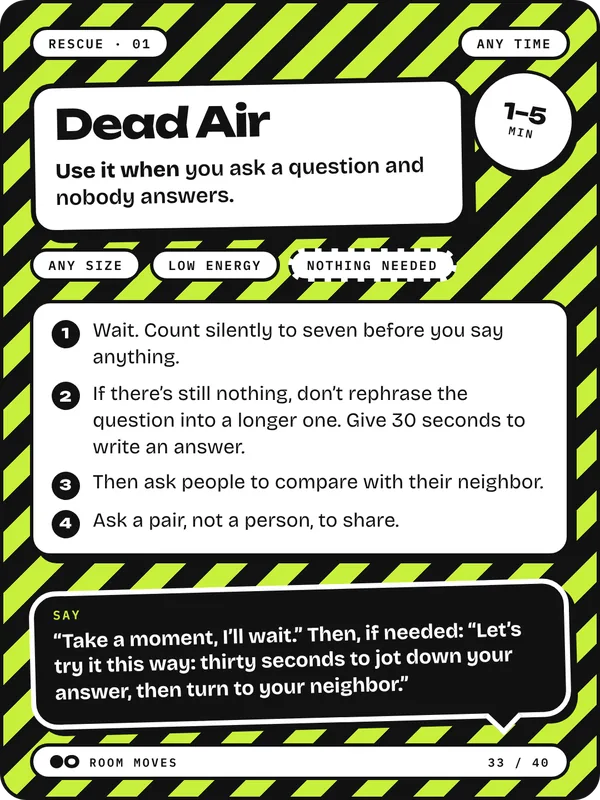
MOVES
Most sessions fail in four ways.
None of them is about the people. They’re about the structure, and each one has a move that fixes it.
Three voices, twenty people
A few people do the talking. The rest nod.
Ideas lost in the queue
People wait their turn, forget, or hold back.
Decisions by echo
The first or most senior opinion sets the tone.
Great session, nothing happens
Everyone leaves energized. Nothing changes.
Six families, one arc.
Five families follow the shape of a good session. The sixth, Rescue, is for the moments when things go sideways. Pick the moment, pull a card, run it.
Rough time shares for a 60–90 minute session.
Open
6 movesEvery voice in the first five minutes.
Start with First WordsGenerate
6 movesMany ideas before judging any.
Start with Quiet StormDeepen
6 movesSmall groups and shared understanding.
Start with Go SmallDecide
6 movesJudge alone, then reveal together.
Start with Blind VoteClose
6 movesOne owner, one date, end on time.
Start with If-ThenRescue
6 movesA way out in under five minutes.
Start with Dead AirWhat to do. Then why it works.
When to use it, the time, group size and energy, the steps, and the exact words to say.
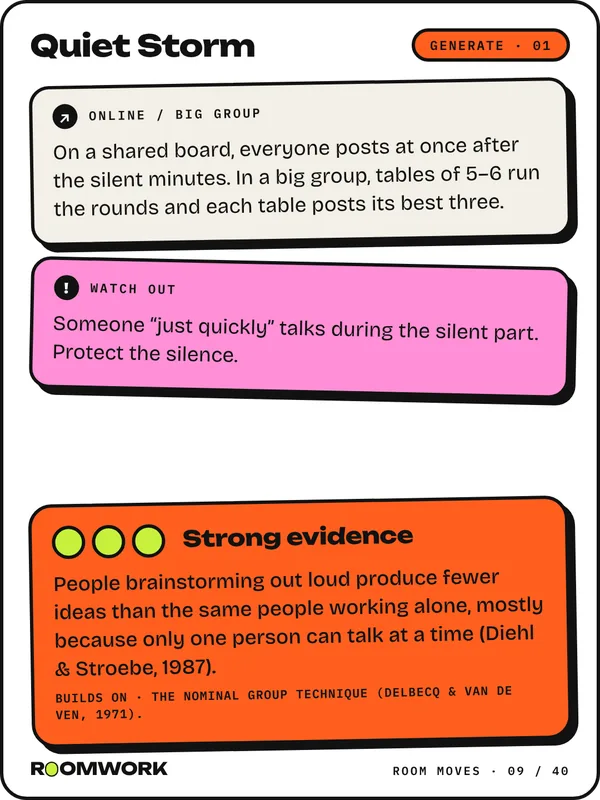
The online or big-group version, the classic mistake, and why it works, with its source.
Every card shows how strong the research behind it is. Practice-based means facilitators have used it for years, but it hasn’t been formally tested.
When the room goes sideways, pull a Rescue card.
Six common emergencies, each with a way out in under five minutes and the first line to say.
Dead Air
Nobody answers your question.
One Loud Voice
One person keeps taking the floor.
Energy Crash
Eyes glazing over after lunch.
Off the Rails
The talk drifts to another topic.
Too Hot
Voices rise and it gets personal.
Going in Circles
Same arguments, no progress.
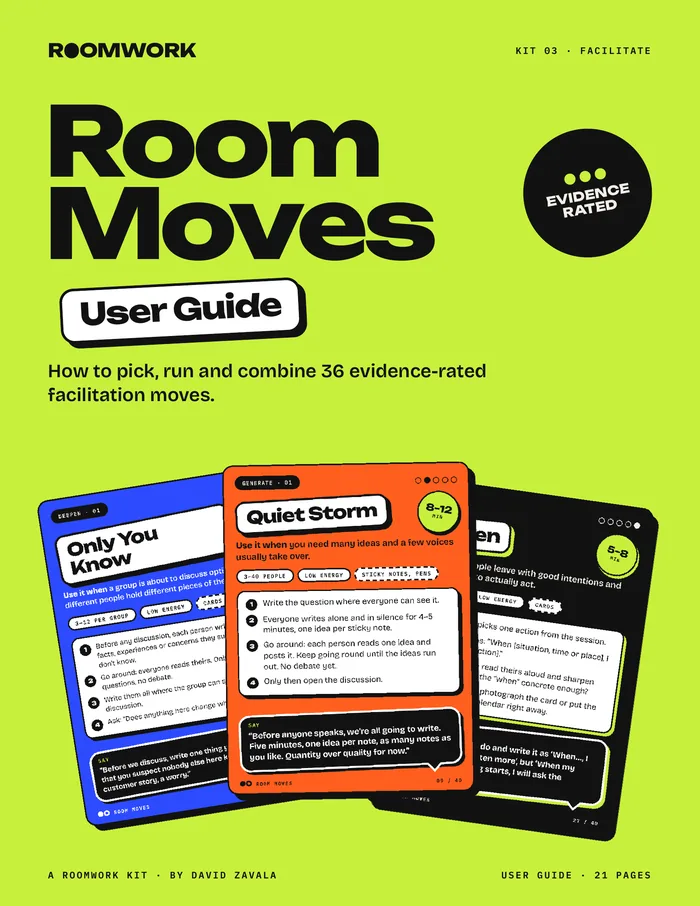
A 21-page guide to run it well.
Why the moves work, how to pick one in 30 seconds, how to plan a session, five ready-made recipes, and a printable planner.
Get Room Moves.
One purchase, instant download through Gumroad. Upgrade by choosing a bigger version.
Run the moves from your screen and plan with AI.
- All 40 cards as a screen PDF, front and back
- 10 AI Facilitation Prompts to plan, adapt, rehearse and follow up
- The Move Library: all 36 moves as text, ready to paste into any AI
The full deck, in print and on screen.
- Everything in the AI Pack
- Printable deck in Letter and A4, with backs and crop marks
- The 21-page User Guide
- 5 session recipes and a printable planner
For teachers, trainers and teams.
- Everything in Complete
- License to use the kit with your own groups
- Run the Room: a 90-minute workshop kit, with 12 scenario cards, to teach others to facilitate
Before you buy.
Do I need facilitation experience?
No. Each card gives you the steps and the exact words to say. The guide has a 10-minute version for your first session.
How big are the printed cards?
3.75 × 5 inches (about 9.5 × 12.7 cm), four per page. Print double-sided, flip on the long edge, and cut along the crop marks.
Does it work online?
Yes. Every card has an online and big-group version on its back, and the guide has a page on running moves online and with 30+ people.
Where does the evidence come from?
From research on classrooms, teams and meetings. The guide lists all 23 sources, and every card shows its rating so you know what you’re standing on.
Can I use it with students?
Yes. Much of the research behind the moves comes from classrooms. Adjust the examples to the age group.
What do the AI prompts do?
They help you build a session plan, adapt a move to your group, find better words, rehearse a rescue and write the follow-up. Paste them into any AI chat assistant, and keep confidential information out of your chats.
Where can I read more about the research?
In The Science of the Room, the book behind both kits. Part 2 explains why sessions underdeliver and the five rules behind the moves. Chapter 1 is free.