Tough Room
24 evidence-based personas to rehearse your pitch against. The user who’s fine without you, the buyer who has to defend the purchase, the angel hunting for one fatal flaw. Rehearse alone, with a partner, with a group or with any AI.
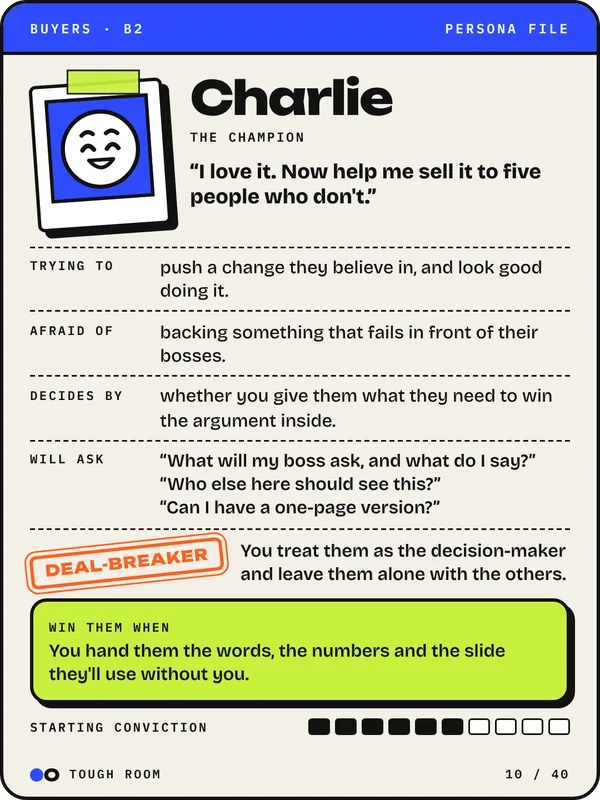
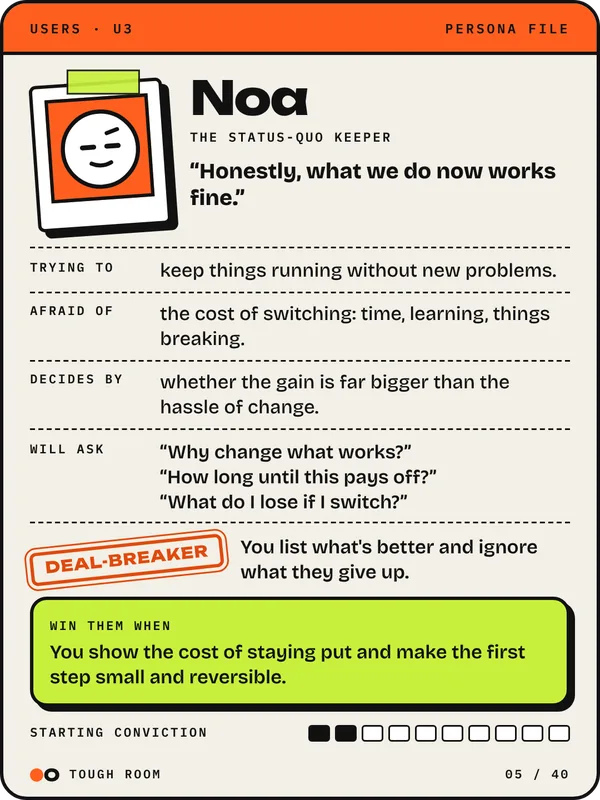
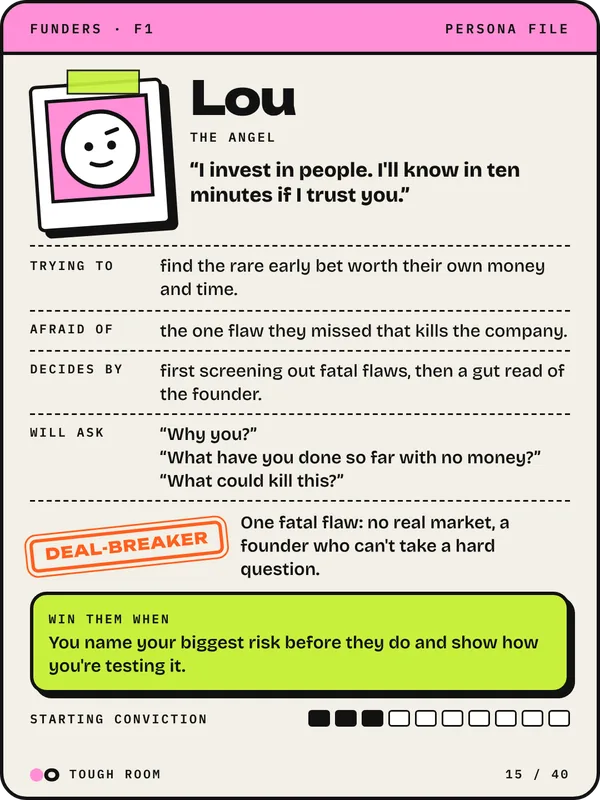
PERSONAS
Most pitches fail for reasons you can’t see from the inside.
Rehearsing against a specific person makes those reasons visible before they cost you the meeting.
You can’t hear your own jargon
People tapping out a song’s rhythm expected half their listeners to name it. 2.5% did. Once you know something, it’s hard to imagine not knowing it.
Newton, 1990, in Heath & Heath, 2006Audiences screen out before they score
In 150 conversations between founders and angel investors, angels didn’t add up strengths. They rejected anything with one fatal flaw, early.
Maxwell, Jeffrey & Lévesque, 2011Preparation beats passion
In a lab experiment and a field study, how prepared founders seemed predicted whether investors funded them. How passionate they seemed did not.
Chen, Yao & Kotha, 2009Doing nothing is your real rival
In 2.5 million recorded sales conversations, 40% to 60% of deals ended with no decision at all, mostly from fear of making a mistake.
Dixon & McKenna, 2022Four rooms. 24 people who decide.
Every pitch meets the same four kinds of listener. Each room has six personas, each built from research on how people in that role decide.
Users
6 personas“Will I actually use this?”
- U1Sasha, Hacker
- U2Robin, Pragmatist
- U3Noa, Status-Quo Keeper
- U4Kai, Daily User
- U5Jules, Outsider
- U6Ari, Backer
Buyers
6 personas“Can I get this approved?”
- B1Morgan, Budget Owner
- B2Charlie, Champion
- B3Remy, Gatekeeper
- B4Taylor, Comparer
- B5Eden, Undecided
- B6Dani, Public Buyer
Funders
6 personas“Will this pay back what I put in?”
- F1Lou, Angel
- F2Max, VC Partner
- F3Kim, Grant Panel
- F4Rio, Demo-Day Judge
- F5Quinn, Lender
- F6Sam, Impact Funder
Allies
6 personas“What’s in it for me and my people?”
- A1Jordan, Executive Sponsor
- A2Billie, Channel Partner
- A3Ash, Journalist
- A4Frankie, Recruit
- A5Nico, Policymaker
- A6Alex, Community Leader
Play any persona the way your listener decides.
The moments that knock a pitch off script.
Plus two guide cards: how to play, and the scorecard.
Who they are. Then how to win them.
What they’re trying to do, what they fear and how they decide, the three questions they’ll ask, their deal-breaker, how to win them, and how convinced they are when you walk in.
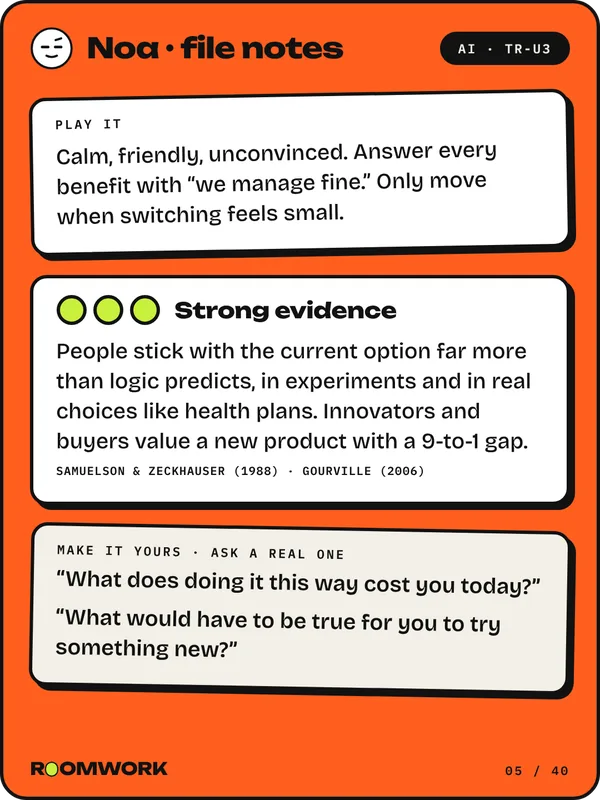
How to play them, why they act that way with its source, two questions to check the card against a real person, and the code of their AI dossier.
Every persona, style and curveball shows how strong the research behind it is. Practice-based means it comes from practitioners’ experience and hasn’t been formally tested.
An AI that doesn’t go soft on you.
Left alone, chat assistants tend to agree with you. The Tough Room prompts give each persona a conviction score, hidden criteria and a deal-breaker, so it only moves when you bring evidence.
- Pitch mode. You pitch; the persona pushes back one question at a time.
- Discovery mode. You interview the persona. Leading questions get a vague yes, as in real life.
- Score. Type SCORE for feedback on six criteria and the one thing to change.
What an AI can’t tell you is what your real customers think. Use AI to rehearse and people to learn: in discovery mode, every score ends with three questions to ask a real person.
A fictional example. Conviction rises only for concrete evidence.
Built to be checked, not believed.
A generic persona can’t know your customers. So every card is a starting point, and the kit shows you how to turn five real conversations into a persona of your own.
Talk to five people in the role. Don’t pitch; ask about the last time it happened. Write down their words the same day, mark what’s evidence and what’s assumption, and the “Make it yours” prompt turns your notes into a dossier you can rehearse against.
- Role, not identity.A persona is defined by its part in the decision, never by age, gender, ethnicity, nationality or class.
- Few traits, the ones that decide.Only what changes how they hear a pitch. Nothing decorative.
- Every trait has a source.The back of each card names the research and rates how strong it is.
- Neutral, swappable names.Sasha, Robin, Kai: names that don’t hint at a gender. Rename them freely.
- A starting point, not the truth.Check every card against real conversations before you rely on it.
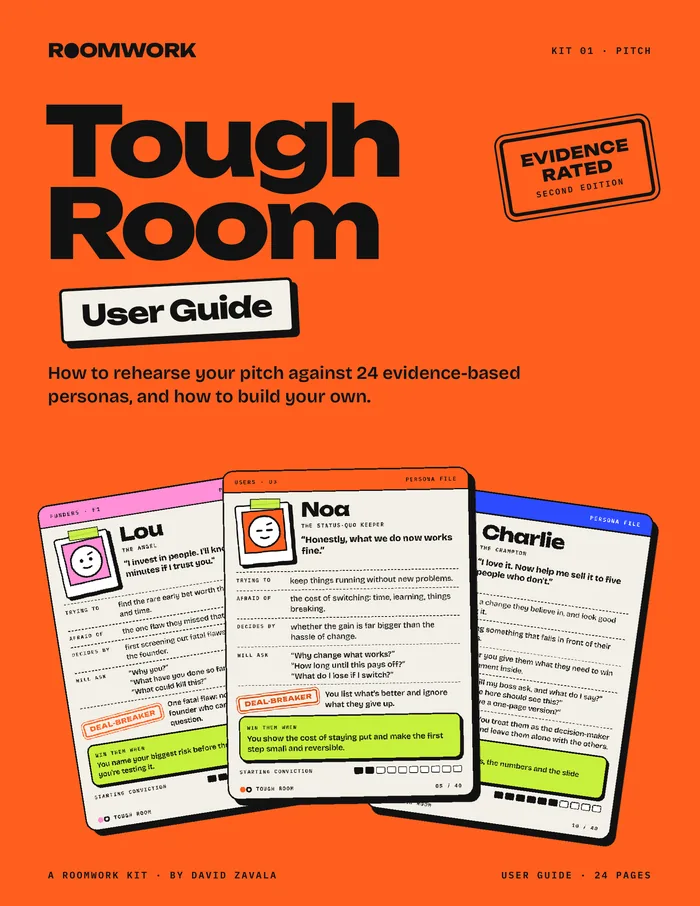
A 24-page guide to play it well.
Why rehearsal works, how the 24 were built, three ways to play, a full round from start to finish, ten recipes for common meetings and a 60-minute workshop.
Get Tough Room.
One purchase, instant download through Gumroad. Upgrade by choosing a bigger version.
Rehearse your pitch with any AI.
- The engine prompt, with pitch and discovery modes
- 24 persona dossiers, 6 decision styles and the curveballs
- A quick guide and the “Make it yours” prompt
- PDF, plus a plain-text file to copy from
The full deck, in print and on screen.
- Everything in the AI Pack
- The 40-card deck to print in Letter and A4, with backs and crop marks
- The deck as a screen PDF
- The 24-page User Guide, with the scorecard and a practice log
For teachers, trainers and programs.
- Everything in Complete
- License to use the kit with your own groups
- Know Your Room: a 90-minute workshop with real interview practice and a build-your-own-persona close
Before you buy.
Do I need a finished pitch?
No. Discovery mode is for the earlier stage: you interview a persona about their problem, which is good practice before real customer interviews.
Are these real people?
No. They’re fictional archetypes of roles in a decision, with neutral names and no age, gender or nationality. Each one is built from published research and rated for evidence. Check them against real conversations with the “Make it yours” method.
Which AI should I use?
Any chat assistant that follows long instructions. Use one persona per chat. If it starts going easy on you, the prompts file gives you the line to type to bring it back. Keep confidential information out of your chats.
How big are the printed cards?
3.75 × 5 inches (about 9.5 × 12.7 cm), four per page. Print double-sided, flip on the long edge, and cut along the crop marks.
Does it work with a class or a team?
Yes. The guide has three ways to play (solo with AI, in pairs, in threes), ten recipes and a 60-minute workshop plan.
Where can I read more about the research?
In The Science of the Room, the book behind both kits. Part 1 explains how listeners decide and where each room of personas comes from. Chapter 1 is free.
What happened to the first edition?
Its eight characters are retired. The second edition replaces them with 24 personas built from research, an evidence rating on every card, decision styles, curveballs and AI dossiers.